
"Trust takes years to build, seconds to break, and forever to repair."
"Trust starts with truth and ends with truth."
(Santosh Kalwar)
Origin of human trust
The evolutionary roots of human trust: Empirical insights from chimpanzees
Trust is essential for building and maintaining social and cooperative relationships. To date, however, little is known about the origins and evolutionary development of human trust, and the few existing studies are inconclusive.
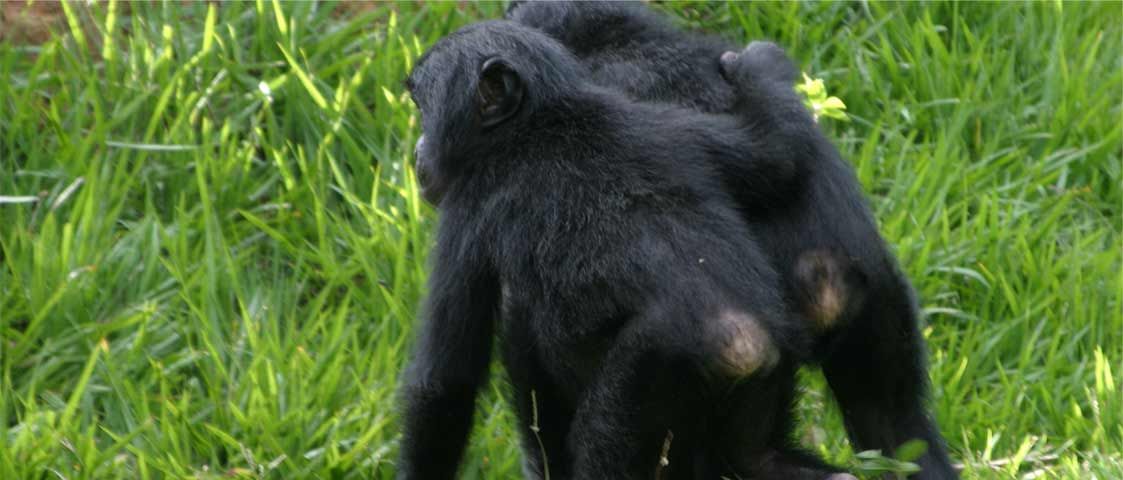
Hence, we study the evolution of trust by focusing on one of humans‘ closest living relatives, the chimpanzee.
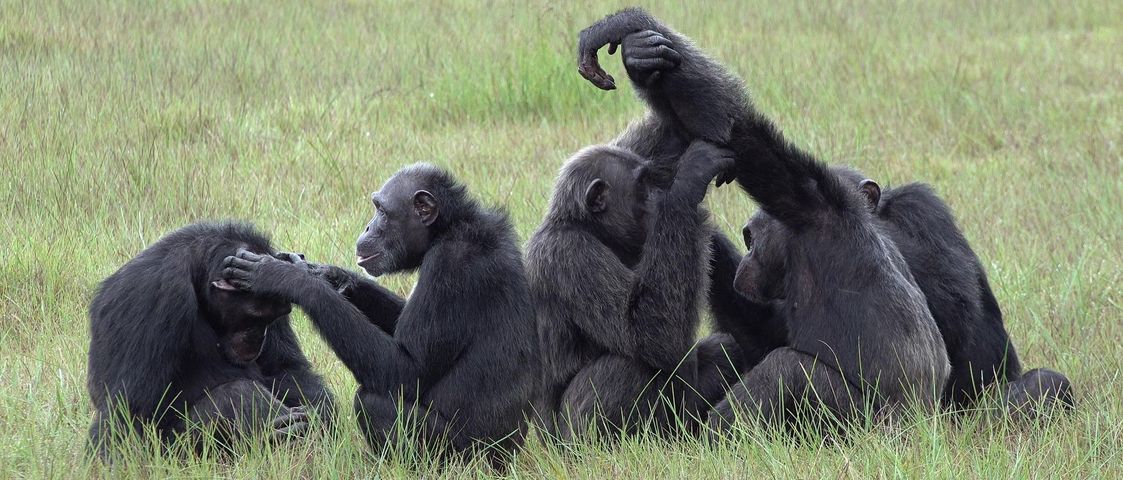
A goal of our long-term, systematic research project on the evolution of trust is to collect and analyze quantitative data on social interactions of chimpanzees in the wild. We investigate whether and in what form trust plays a role among great apes and what influence social interactions have on trust, such as food sharing or conflict resolution.
The project is funded by the Sievert Foundation for Science and Culture from April 2026 through March 2029.
Medical cognition
Tackling diversity of behaviors and involved cognitive abilities
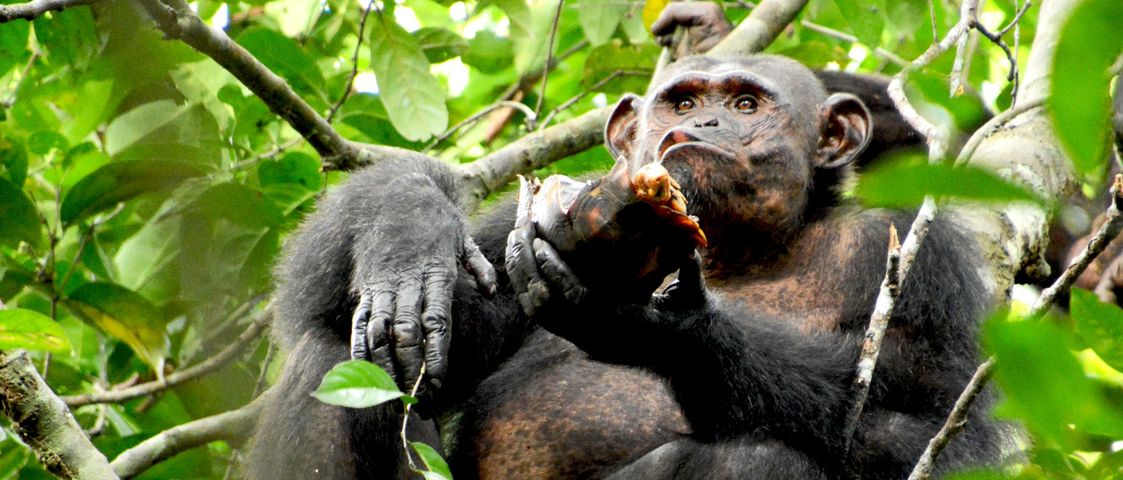
Medical practices are deeply rooted in human history and culture with first evidence possibly dating back to Middle Paleolithic hominins. The variety of organic matter utilized is huge, ranging from plants, plant material, to insects and animal matter for prophylactic and therapeutic purposes.
Medical practices involve self-medicative behaviors, where individuals ingest or apply things that make them feel better and prevent diseases, but also cooperative, altruistic-medical behaviors, whereby helpers receive no immediate benefits and individuals helped are non-related. They have been implicated with highly complex cognitive skills such as social learning, conscious decision-making, future planning, and empathy, a cognitive tool-kit referred to medical cognition.
The ManyMedications database aims to connect researchers interested in self-and-other-medicative behaviors in animals with a special focus on medical cognition, wound care, use of external matter (e.g., plants, animals, soil) and accompanying social behaviors. For more information please click here.
The Turn-taking project (2017-2025)
Human language is underpinned by a universal infrastructure — cooperative turn-taking — which has been suggested as an ancient mechanism bridging the existing gap between the articulate human species and its inarticulate primate cousins.
However, we know remarkably little about turn-taking systems of non-human animals, and methodological confounds have often prevented meaningful cross-species comparison.
The project 'Taking turns: The ‘missing’ link in language evolution?' was funded by an ERC-Consolidator Grant of the EU and provided the first rigorous test of whether cooperative turn-taking is uniquely human, ancestral in the primate lineage, or evolved independently in different species.