Bachelor/Master theses
Guidelines
If you are interested in writing a thesis with our group, please go first through the information on our website and the following guidelines. Take a look at materials from the Stud.IP course materials on “Introduction to Animal Cognition” (WS 2025/2026), our CBC-guidelines, and the resources below!
General steps to take
- Check our website for ongoing projects and research topics and contact the person your idea connects to (see Team).
- Write an abstract (500-1000 words) with a project idea.
- Meet with supervisor(s) (PI and group member) to discuss topic and research question. Write down meeting notes and send them to us (PI and group member).
- Attend the Language and Communication Colloquium and Primate Communications Seminar (SS2026; WS 2026/2027).
- Register your thesis with the examination office.
- Send us your thesis sketch, including a hypothesis and/or 2-3 research questions and operationalization of research questions and schedule a second supervision meeting with concrete question.
- Send us your line of argumentation and results graphs 4 weeks before thesis submission.
- Write and submit your thesis.
All thesis students should attend the Language and Communication colloquium and the Primate Communications Seminar offered on StudIP.
If you need support in English scientific writing, you can also turn to the UOS English Writing Center:
https://www.uni-osnabrueck.de/en/studying/contact-points-and-advice/writing-center/english-writing-consultation
When writing your thesis, please also consider the IKW guidelines for the use of AI tools:
https://www.uni-osnabrueck.de/fileadmin/fb8/ikw/Studieren/Study_Information/AI_Tools_Guidelines.pdf
Please contact the CBC-assistant Dorothee Möllmann at office-cbc[at]uos.de for appointments and ongoing in-lab studies (also for lab rotations).
Potential theses topics
If you are interested in writing your thesis with us, you may choose one of the following potential topics:
- Title: Evaluating automated pose estimation for wild primate behavior studies
Main supervisor: Dr. Filipa Abreu, Prof. Simone Pika
Brief Description: Tracking movement accurately is important for understanding behavior and cognition in many animals. However, automated pose estimation methods do not always perform consistently across different species, contexts and recording conditions. This projects investigates how automated pose estimation methods, such as DeepLabCut, can be used to reliably track and analyze social interactions in primates.
Data: Video footage of chimpanzees, common marmosets and sooty mangabeys.
Method: Machine learning to automatically track the position of specific body parts across video frames.
Requirement: Familiarity with machine learning or computer vision.
- Title: Gaze in affiliative interactions across species
Main supervisors: Dr. Filipa Abreu, Dr. Jolinde Vlaeyen and Prof. Simone Pika
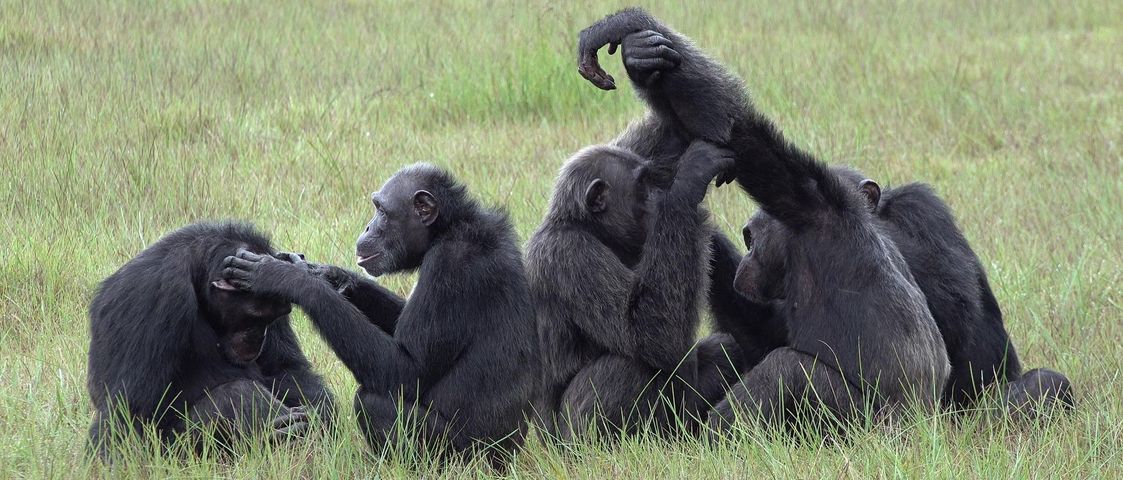
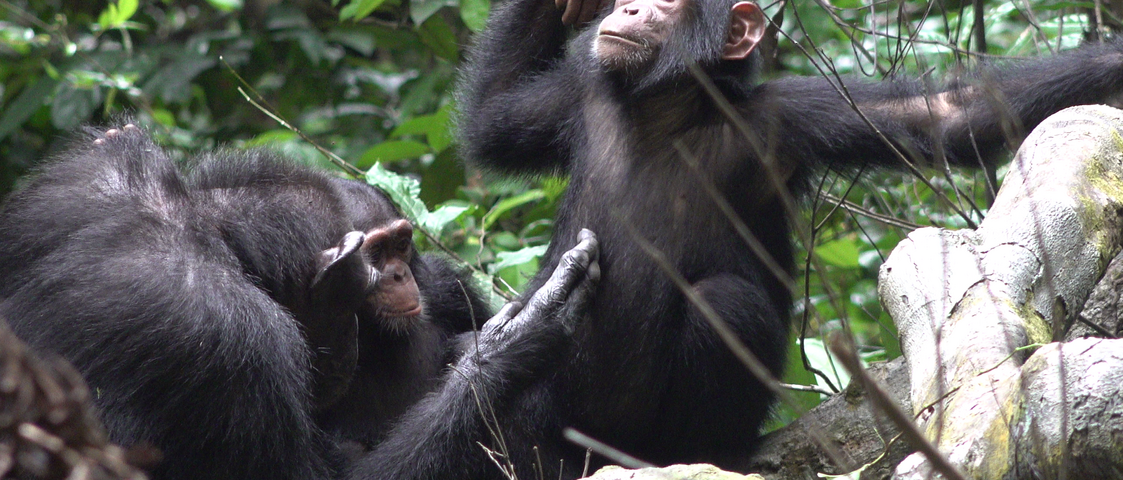
Brief Description: Coordination is essential for efficient social interactions, where certain signals or cues can play an important role. This project examines whether gaze, particularly mutual gaze, plays a role in coordination during social interactions, such as grooming, or whether coordination is instead primarily achieved through other modalities such as gestures.
Data: Tabulated data of coded video footage of chimpanzees, bonobos, common marmosets and sooty mangabeys, including the gaze and used gestures of the involved individuals.
Method: Statistical analysis of coded video data to determine cases of mutual gaze during an interaction and whether it predicts the following "next move".
Requirement: N/A
- Title: Automated individual identification of coatis for cognitive research
Main supervisors: Dr. Filipa Abreu, Dr. Leonardo Chaves and Prof. Simone Pika
Brief Description: Reliable individual identification is essential for studying behavior and cognition over time, but is usually slow and difficult when done manually. This project explores how computer vision methods can be used to automatically identify and track individual coatis (Nasua nasua) in the wild, with the goal to develop a machine learning pipeline that can recognize individual coatis from camera trap video footage.
Data: Camera trap footage of coatis.
Method: Deep learning used to automatically identify individuals based on their unique visual features.
Requirement: Familiarity with machine learning or computer vision.
- Title: Macroecological patterns in medicinal plant use across tropical Africa and Amazonia
Main supervisor: Dr. Leonardo Chaves and Prof. Simone Pika
Brief description: Plants used as remedies for ailments are found across human communities, with some serving similar functions in separate communities. However, the extent to which similarities and differences in medicinal plant use are shaped by ecological or cultural factors remains poorly understood. This project investigates how ecological and cultural factors shape large-scale patterns in medicinal plant use across tropical Africa and Amazonia. Using data compiled through a large systematic review of medicinal plant lists from multiple human communities, the study will examine how variables such as environmental heterogeneity, productivity, geographical distance, and proxies of cultural isolation may explain similarities and differences in local pharmacopoeias.
Data: Large tabulated data of medicinal plant use across human communities.
Method: Statistical analysis of tabulated data between environmental, geographical, cultural variables and pharmacopoeial similarity.
Requirement: N/A
- Title: Chemical difference between the male and female insects used by the chimpanzees in open wound care
Main supervisor: MSc. Harshith Koppa Guruswamy and Prof. Simone Pika
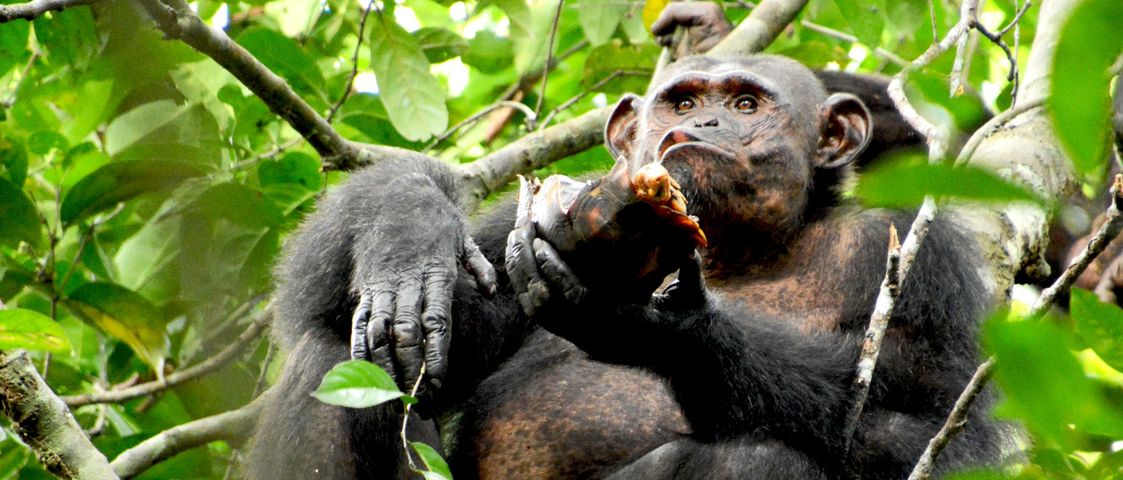
Brief description: Chimpanzees in Gabon and Uganda have been observed applying flying insects to their open wounds, but the chemical basis for this behaviour remains unclear. This project analyses the cuticular hydrocarbon profiles ("a unique chemical fingerprint") of both male and female insects to identify any chemical differences. Since it is unknown which sex of insects chimpanzees utilise, the project will identify potential candidates that may explain the use of insects in wound care.
Data: Insect samples collected from the chimpanzee habitat in Gabon
Method: Gas chromatography-mass spectrometry on insects at University of Würzburg in collaboration with Dr. Erik Frank.
Requirement: Part-time at University of Würzburg for analyses.